
Tag Archive for: New Hampshire physical theapy

Why We Age Faster Than We Should – And How Medicine 3.0 Changes Everything

Why We Age Faster Than We Should — And How Medicine 3.0 Changes Everything (Portsmouth, NH)

If you haven’t yet read Outlive: The Science and Art of Longevity by Dr. Peter Attia, I highly recommend it—especially if living your healthiest years right now matters to you. Dr. Attia, a physician known for his work in healthspan and preventative medicine, explains why our current medical system (what he calls Medicine 2.0) focuses too heavily on treating disease instead of preventing it.

In “Outlive,” Attia introduces Medicine 3.0, a proactive and prevention-based approach to longevity. Instead of waiting for disease to show up, Medicine 3.0 focuses on early action, long-term strategy, and building the physical capacity needed to stay healthy and independent through your 60s, 70s, and beyond.

Central to Attia’s philosophy are the “Four Horsemen” of chronic disease:

  • metabolic dysfunction
  • cardiovascular disease
  • cancer
  • neurodegenerative decline

These conditions often appear in our 50s and 60s—but the biological changes that cause them begin years (often decades) earlier. That’s why the most powerful time to intervene is long before symptoms appear. And that applies directly to the work I do every day as a mechanical pain specialist here in Portsmouth, NH.


Where Most People Overlook Longevity: Musculoskeletal Health

You can fuel your body with nutrient-dense food, build strong muscles, and improve your cardiovascular capacity—but if you’re dealing with chronic back pain, knee pain, hip pain, or shoulder pain, it becomes nearly impossible to maintain the type of movement needed for long-term health.

Just like the Four Horsemen, musculoskeletal problems usually develop silently from small mechanical issues that go unaddressed for too long. When identified early, nearly all of these issues are fixable—and often preventable.

This is exactly where Medicine 3.0 and mechanical pain science overlap:

  • early intervention
  • optimizing function
  • preventing decline
  • treating problems while they’re small—not after they become debilitating

Below are five Medicine 3.0 principles that apply directly to your muscles, joints, and mobility.


1. Movement Quality Matters More Than You Think

Longevity isn’t just about being active—it’s about moving well. Poor movement patterns, stiffness, or instability eventually lead to breakdown, even if you’re exercising consistently.

  • Medicine 2.0: Wait until something hurts
  • Medicine 3.0: Optimize movement before pain appears
  • Good joint mobility, core stability, balance, and coordination are fundamental for long-term health, independence, and injury prevention.

2. Small Aches Become Big Ones When Ignored

A tight low back after sitting…
An achy knee after pickleball…
A stiff neck when you wake up…

These are early warning signs. Medicine 2.0 teaches you to ignore them until they become severe. But by that point, the problem is harder—and more expensive—to solve.

Mechanical issues are easiest to fix early, and addressing them now protects your joints, prevents chronic pain, and helps you stay active well into older age.


3. Your Mobility Declines Long Before You Notice It

Just like cardiovascular decline, mobility fades slowly over decades. You lose hip extension, ankle mobility, rotational strength, and postural control long before you notice anything in daily life.

The good news?
Mobility is highly trainable, even into your 70s and 80s.

The key is to address restrictions early—not once you already “feel old” or start modifying activities due to stiffness.


4. Strength Training Doesn’t Work When Form Is Poor

Strength training is one of Attia’s non-negotiables for longevity. But strength training performed with poor mechanics can do more harm than good.

Learning to:

  • hinge properly
  • stabilize your hips
  • engage your core
  • align your spine

…keeps your joints safe and allows you to build strength without injury.

The best time to learn proper mechanics is before something breaks down—not after you’re dealing with a herniated disc or chronic tendon pain.


5. Imaging Shows Structure—But Not the Full Story of YOU

X-rays and MRIs show bones and tissues, but they don’t show mechanical dysfunction, such as why:

  • your back hurts more with sitting
  • your hip improves with walking
  • your knee flares after lifting

Most musculoskeletal pain is mechanical in nature, meaning it responds best to mechanical solutions like movement, load management, and corrective exercise—not just medication or rest.

This aligns perfectly with Medicine 3.0:
Treat the whole person, not just the scan.


The Bottom Line: You Have More Control Over Your Future Than You Think

Medicine 3.0 teaches us that aging isn’t something that just “happens”—it’s something we can influence with early, strategic action.

Nowhere is this more true than in your musculoskeletal system.

When you:
✔ take small signals seriously
✔ strengthen intelligently
✔ move with intention
✔ address problems early
✔ ask for help before pain becomes disabling

…you protect your ability to stay healthy, active, independent, and fully engaged in life for decades to come.


About Dr. Carrie Jose

Dr. Carrie Jose, DPT, is a Physical Therapy Specialist and Mechanical Pain Expert and the owner of CJ Physical Therapy & Pilates in Portsmouth, NH. She writes for Seacoast Media Group and helps active adults stay mobile and pain-free without medications, imaging, or surgery.

To get in touch or request a discovery visit, visit cjphysicaltherapy.com or call 603-380-7902.
Foot and Heel Pain: How to Move Beyond Short-Term Relief

If you’ve ever stepped out of bed and felt a stabbing pain in your heel, there’s a good chance you were experiencing plantar fasciitis – one of the most common causes of heel pain in adults.

More than two million Americans struggle with it each year. Cortisone shots, orthotics, and rest are often prescribed, but these strategies usually provide only temporary relief – and in some cases, can even prolong the problem.

Recovering from plantar fasciitis starts with understanding why it happens in the first place. Once you know the root cause, the path forward becomes clearer – and today there are modern, natural options that focus on healing rather than simply masking pain. That’s the aim of this article. 

So let’s dive in: how do you move past short-term relief and get back to doing the activities you love, without heel pain holding you back?

What is Plantar Fasciitis?

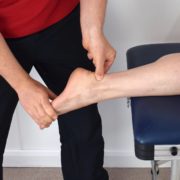
The plantar fascia is a thick band of tissue running along the bottom of your foot, connecting your heel bone to your toes. Its job is to support your arch and absorb shock when you walk, run, or jump. When this tissue is overloaded, it can become irritated – and if that continues, the fascia begins to degenerate. The result is plantar fasciitis, marked by pain at the base of the heel, especially during the first few steps in the morning or after long periods of sitting.

Many assume plantar fasciitis is an inflammatory condition, but that isn’t the full picture. It’s more accurately a degenerative process, where the collagen fibers of the fascia weaken and lose their ability to tolerate load. This helps explain why treatments aimed only at reducing inflammation, such as cortisone shots, rarely provide lasting relief.

Why Traditional Treatments Fall Short

Cortisone injections have long been a standard treatment for heel pain. While they may reduce pain briefly, research shows the benefit is temporary – often only a few weeks or months. Repeated injections also carry risks. Cortisone does not repair the damaged fascia – in fact – it can weaken collagen and allow the problem to persist. Worse, by masking pain, injections often encourage continued activity that aggravates degeneration.

Custom orthotics are another common approach. These shoe inserts, often prescribed by podiatrists, can redistribute pressure and provide comfort in the short term. But research shows little difference between costly custom orthotics and high-quality prefabricated ones. More importantly, they do not address the underlying weakness or tissue degeneration. Once the initial benefit wears off, the pain often returns – and relying on orthotics indefinitely is impractical and prevents restoration of natural foot strength.

Both cortisone and orthotics may play a role in daily function. But if the goal is to truly heal the fascia and return to full activity, more is needed.

Stimulating Healing – Don’t Mask It

Instead of suppressing symptoms, you want to encourage true healing and pair it with corrective strengthening to keep the tissue healthy. Modern treatments such as shockwave therapy, EMTT, and PRP aim to jump-start your body’s own repair mechanisms instead of impeding them.

A good place to start is extracorporeal shockwave therapy, or ESWT. This non-invasive treatment sends acoustic waves into the fascia to create controlled “microtrauma,” which stimulates collagen regeneration and promotes tissue recovery.

An important complement is Extracorporeal Magnetotransduction Therapy, or EMTT. A 2022 multicenter study in the Journal of Clinical Medicine found that 80 percent of patients with chronic musculoskeletal conditions improved after EMTT, with more than 75 percent maintaining benefits six to twelve months later. In practice, EMTT appears to extend and amplify the positive effects of shockwave therapy by sustaining cellular activity long after treatment sessions.

For those needing an additional boost, platelet-rich plasma (PRP) injections are another option. Though invasive, PRP delivers concentrated growth factors directly into damaged tissue, enhancing the body’s natural healing. A 2023 randomized trial in BMC Musculoskeletal Disorders reported that PRP outperformed corticosteroid injections at reducing pain, improving function, and thinning the plantar fascia at six months. Case reports in the German Journal of Sports Medicine also show excellent outcomes when ESWT and PRP are combined, including full return to sport in runners who had failed other treatments.

Taken together, these therapies form a layered strategy: shockwave jump-starts the healing cascade, EMTT helps sustain it, and PRP provides an extra regenerative boost (if needed). When combined with a structured rehabilitation program, this approach offers a pathway to lasting recovery rather than temporary relief.

Beyond the Foot: Make the Healing Last

What many don’t realize is that chronic plantar fasciitis can also be linked to dysfunction higher up the chain. The pelvic floor, deep core muscles, and hip stabilizers all influence how forces travel through the legs and feet. If these areas are weak or poorly coordinated, the plantar fascia often absorbs stress it wasn’t designed to handle.

Clinical experience shows that individuals with weak core and pelvic floor control often develop altered gait mechanics, leading to excessive strain on the heel with each step. In these cases, treating only the fascia leaves the root cause unaddressed.

A comprehensive plan should therefore include strengthening of the core and pelvic floor, along with intrinsic foot training, alongside regenerative therapy. When these muscles are retrained to provide stability and load-sharing, the fascia is no longer forced to work alone. Over time, this reduces reinjury risk and creates a long-term fix. In essence, regenerative therapy jump-starts tissue healing, while strengthening ensures the fascia remains supported once it recovers.

The Bottom Line

Foot and heel pain can be stubborn, and plantar fasciitis in particular has a reputation for lingering. Cortisone shots and orthotics may provide temporary relief, but they do not restore the health of the fascia or solve the underlying problem. Regenerative therapies, especially shockwave, are supported by strong evidence for reducing pain and improving function in people with chronic plantar fasciitis. When combined with mobility, strength training, and – critically – core and pelvic floor retraining, they provide a durable solution that not only relieves pain but helps prevent it from coming back.

If your heel pain has been persisting for months, it’s worth considering a plan that goes beyond masking symptoms. Lasting relief comes when you treat both the tissue that hurts and the movement system that created the overload in the first place.

Dr. Carrie Jose, Physical Therapy Specialist and Mechanical Pain Expert, owns CJ Physical Therapy & Pilates in Portsmouth, NH, and writes for Seacoast Media Group. If local to Portsmouth, NH, and looking for help, request a FREE Discovery Visit with one of her Specialists by CLICKING HERE.